
AI Should Empower Humans, Not Replace Them
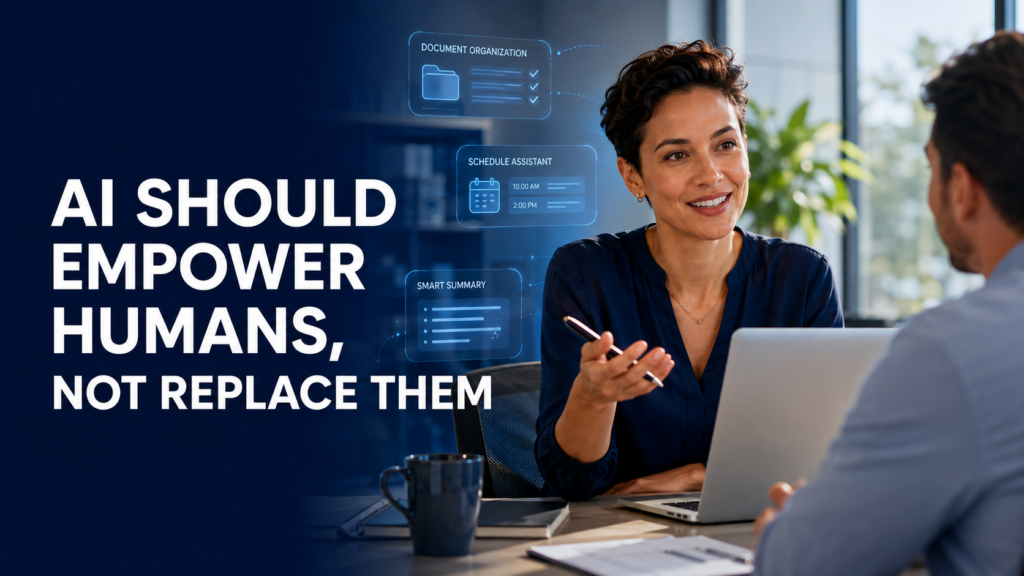
The Purpose of Artificial Intelligence Is to Make People Better at Their Jobs—not Eliminate the People
The central principle: AI should eliminate administrative friction—not the human relationships, judgment, and accountability that make work valuable.
Artificial intelligence is rapidly changing how companies recruit employees, communicate with customers, generate sales, analyze information, and complete everyday administrative work. Used responsibly, AI can save time, reduce repetitive work, improve consistency, and give employees better information for making decisions. It can help a salesperson prepare for a call, help a customer service representative find an answer, or help a hiring manager organize applications.
But somewhere along the way, some business leaders began confusing automation with replacement.
Instead of asking how AI can help employees perform better, they ask how many employees AI can eliminate. Instead of using technology to improve the customer experience, they put an automated barrier between customers and the people who can actually help them. Instead of making hiring more personal and efficient, they require job applicants to speak to artificial interviewers that cannot understand a person’s character, potential, humor, nervousness, or life experience.
That is not responsible innovation. It is cost cutting disguised as progress.
AI should not be used to remove human beings from interactions in which judgment, empathy, trust, persuasion, creativity, accountability, and genuine conversation matter. It should automate the mundane parts of a process that run in the background so a human being can do the meaningful parts of the job more effectively.
The best future for AI is not one in which machines replace workers. It is one in which people equipped with useful technology become more capable, productive, informed, and responsive.
The Difference Between Automation and Human Replacement
Not every use of automation is harmful. Businesses have used technology to automate repetitive tasks for decades. Accounting software calculates totals. Customer relationship management systems organize contacts. Scheduling tools coordinate appointments. Spam filters remove unwanted email. None of these applications necessarily destroys the human relationship at the center of the work.
The important question is not whether a company uses AI. The question is what role AI is being asked to play.
Assistive automation handles repetitive, predictable, administrative tasks. It may summarize information, organize records, identify patterns, draft routine material, or remind an employee about the next step. A person remains responsible for the decision, communication, and outcome.
Replacement automation attempts to remove the person from a role, especially from moments requiring trust or judgment. It asks AI to interview a candidate, persuade a customer, settle a sensitive complaint, evaluate an employee’s character, or deliver an important decision without meaningful human involvement.
That distinction matters.
When AI works quietly in the background, it can reduce busywork and free employees to concentrate on customers, ideas, and results. When it is pushed into the foreground as a substitute for people, the experience often becomes colder, more frustrating, and less accountable.
Efficiency should be measured by more than how few people remain on the payroll. A process is not truly efficient if it saves the company five minutes but wastes an hour of the customer’s time. It is not innovative if it lowers labor costs while damaging trust, losing qualified candidates, or forcing employees to repair problems created by automation.
AI Should Not Interview Job Candidates
A job interview is not merely a data-collection exercise. It is a human conversation in which both parties evaluate whether a working relationship makes sense.
The employer is assessing the candidate’s experience, communication, judgment, attitude, adaptability, and potential. At the same time, the candidate is evaluating the company’s culture, expectations, leadership, and professionalism. That mutual evaluation is one of the most important parts of hiring.
An AI interviewer weakens that process.
A candidate may be asked to stare into a camera and answer prerecorded or machine-generated questions without receiving natural feedback. There may be no smile, follow-up question, clarification, or genuine exchange. The system may analyze word choices, response length, facial movements, vocal characteristics, or other signals that do not reliably reveal whether the person will succeed in the job.
This format can also penalize people for being human. Strong candidates may be nervous on camera, speak with an accent, communicate differently because of a disability, pause to think, or use a style that an automated system was not designed to interpret fairly. A human interviewer can recognize context, ask a thoughtful follow-up question, and reconsider a first impression. A machine can turn a questionable assumption into a score.
Hiring also requires accountability. If a candidate is rejected, who owns the decision? A responsible employer should be able to explain the job-related reasons for choosing one applicant over another. “The algorithm ranked you lower” is not meaningful accountability.
AI can still improve recruiting when it supports—not replaces—the people involved. It can:
- Coordinate interview times and send reminders.
- Organize résumés for human review.
- Compare applications with clearly defined, job-related qualifications.
- Remove duplicate records and repetitive administrative work.
- Help a recruiter draft consistent interview questions.
- Summarize a human-conducted interview, with the candidate’s knowledge and appropriate safeguards.
- Track where applicants are in the hiring process.
Those uses give recruiters more time to speak with candidates. They do not turn candidates into data points and hiring managers into spectators.
No one should be required to prove their humanity to a machine before being allowed to speak with a human employer.
Sales Requires Human Trust and Human Judgment
Sales is another area in which businesses are tempted to replace people with automated chat agents, artificial voices, and mass-generated messages. The attraction is obvious: a bot can contact thousands of prospects, operate continuously, and produce a high volume of activity at a low apparent cost.
But activity is not the same as selling.
Real sales involves listening. A skilled salesperson recognizes uncertainty, asks follow-up questions, understands context, and changes direction based on what the prospect actually needs. The salesperson may discover that the original request is not the real problem. They may explain a tradeoff, admit that a product is not a good fit, or recommend waiting instead of buying immediately.
Those choices require judgment and accountability.
Trust is especially important when the purchase is expensive, complex, personal, or consequential. A business owner choosing a marketing agency, a family hiring a contractor, or a company selecting a long-term service provider is not simply requesting information. The buyer is deciding whether to trust another person or organization with money, time, access, and reputation.
An AI sales agent can imitate a conversation, but imitation is not a relationship. If customers believe they are speaking with a person and later discover they were interacting with a machine, the company may gain a lead while losing credibility. Deception is not a sustainable sales strategy.
AI is more useful when it equips human salespeople. It can research a prospect, summarize previous conversations, update records, identify unanswered questions, create a first draft of a proposal, or remind the representative when a follow-up is due. It can reduce the time spent searching through notes and entering data after a call.
The salesperson should still conduct the conversation, understand the customer, make the recommendation, negotiate the agreement, and stand behind what was promised.
The right model is a salesperson with an intelligent assistant—not an artificial salesperson pretending to be human.
Customer Service Cannot Be Reduced to a Chat Window
Anyone who has been trapped in an automated support loop understands the difference between automation that helps and automation that obstructs.
The customer explains the problem. The bot offers an unrelated article. The customer tries again. The bot repeats the same choices. The customer asks for a representative, but the system refuses to transfer the conversation until several more questions are answered. By the time a person becomes available, the customer is more frustrated than when the interaction began.
This is not customer service. It is customer containment.
Businesses often defend these systems by saying that customers prefer fast answers. Customers do appreciate speed, but only when the answer is useful. A fast wrong answer is not better than a slightly slower correct one. Convenience cannot be measured by the company’s reduced call volume while ignoring the customer’s unresolved problem.
Human representatives are especially important when a situation is confusing, emotional, unusual, financially significant, or urgent. A billing dispute, canceled reservation, delayed order, service failure, or account problem may not fit neatly into a scripted category. The customer may need someone who can listen, recognize the seriousness of the situation, make an exception, or take ownership until the issue is resolved.
AI can help customer service teams tremendously behind the scenes. It can retrieve account details, surface relevant policies, translate messages, categorize requests, suggest possible responses, summarize long case histories, and flag urgent concerns. It can answer genuinely simple questions, such as posted business hours or the status of a routine order, as long as customers are clearly told they are using automation.
However, every automated service channel should provide a simple path to a human being. Customers should not have to defeat the bot to earn the right to speak with someone.
A helpful standard is straightforward: use automation for simple information and administrative routing; use people for judgment, exceptions, emotions, and resolution.
The Hidden Cost of Removing Humans
Replacing employees may appear to produce immediate savings, but the long-term costs are often hidden in other parts of the business.
A company may reduce its customer service staff, only to experience higher customer churn. It may automate recruiting, only to lose strong applicants who refuse to participate in an impersonal process. It may deploy AI-generated sales outreach at massive scale, only to damage its domain reputation and brand credibility. It may eliminate experienced employees, then discover that no database contains the informal knowledge those employees used to solve unusual problems.
Human workers do more than complete the tasks listed in their job descriptions. They remember exceptions, notice changes, question strange results, calm frustrated customers, teach new employees, protect relationships, and recognize when a procedure no longer makes sense. Much of this value is difficult to capture in a productivity dashboard.
There is also a dangerous cycle that can develop when businesses remove too many people. Customers receive worse service, so complaints increase. Remaining employees become overloaded, so the company adds more automation. The automated systems create additional confusion, so employees spend more time correcting errors. Management then interprets the resulting delays as proof that still more automation is needed.
The original problem was not that people were inefficient. It was that leadership treated human contribution as an expense to eliminate instead of an asset to strengthen.
Work Gives People More Than a Paycheck
The debate about AI and employment is not only an economic argument. Work is also connected to dignity, identity, contribution, skill, independence, and community.
People support families through their jobs. They develop expertise, build relationships, solve problems, and take pride in being useful. Of course, not every task is meaningful, every workplace is healthy, or every job should remain unchanged forever. Technology has always transformed occupations, and some tasks should be automated because they are dangerous, exhausting, or unnecessarily repetitive.
But there is a major difference between improving work and treating workers as obsolete.
If the primary objective of AI adoption is to displace as many people as possible, society may gain cheaper transactions while losing opportunity, stability, and trust. Businesses depend on customers who earn incomes. Communities depend on people who can support themselves. An economy cannot remain healthy if every organization tries to eliminate workers while still expecting consumers to keep buying.
Responsible innovation must consider who benefits from productivity gains. If AI allows an employee to accomplish more, the result should not automatically be fewer employees doing more work under greater pressure. The benefit can take other forms: better service, shorter workweeks, additional training, higher-quality output, faster response times, new products, business growth, or more time for complex and creative responsibilities.
Technology should help create better jobs, not merely fewer jobs.
Human Oversight Is Not a Ceremonial Checkbox
Many organizations claim that a person remains “in the loop,” but human oversight is meaningless if the employee has no time, information, authority, or incentive to challenge the system.
Imagine that an AI tool recommends rejecting a candidate, denying a refund, lowering an employee’s performance rating, or prioritizing one customer over another. If the human reviewer simply approves the recommendation because the system is assumed to be objective, the person is not making a decision. The employee is serving as a rubber stamp.
Real human oversight requires several things:
- The person must understand what the system is doing well enough to question its output.
- The person must have access to the relevant underlying information.
- The person must have enough time to review the recommendation thoughtfully.
- The person must possess the authority to override the system.
- The organization must not punish employees for disagreeing with the technology.
- The final decision must have a clearly identified human owner.
AI can produce confident answers that are incomplete, inappropriate, or simply wrong. It does not bear the consequences of a bad hiring choice, a broken promise to a customer, or an unfair decision. People and organizations do. Therefore, responsibility cannot be delegated to the software.
What Responsible AI at Work Should Look Like
A human-centered approach begins with job design. Before buying an AI product, leaders should talk to the employees who perform the work and identify where time is being wasted.
Which steps are repetitive? Where is information difficult to find? What causes unnecessary delays? Which administrative requirements prevent employees from serving customers? Where do errors usually occur? Which tasks require experience, emotional intelligence, negotiation, creativity, or discretion?
The answers reveal where AI may be useful and where a person must remain central.
Responsible implementation should follow several principles.
1. Automate tasks, not relationships
Let AI schedule the meeting, organize the notes, or retrieve the record. Let a person conduct the interview, advise the customer, resolve the complaint, and build the relationship.
2. Keep humans responsible for consequential decisions
Hiring, firing, discipline, compensation, credit, healthcare, legal matters, and other high-impact decisions should never be surrendered to an automated score. AI may supply information, but an accountable person must evaluate the evidence and own the outcome.
3. Be honest when customers are interacting with AI
An AI system should not pretend to be a human employee. People deserve to know what they are interacting with and what the system can and cannot do.
4. Provide easy access to a person
Automation should never become a wall. If a customer, employee, or applicant needs human assistance, escalation should be simple, visible, and timely.
5. Measure quality, not just labor savings
Companies should track resolution rates, customer satisfaction, applicant completion, error rates, employee workload, repeat contacts, retention, and trust—not merely headcount reduction or the number of automated interactions.
6. Train employees to use and challenge AI
Workers need practical training that covers the tool’s purpose, limitations, privacy concerns, and escalation procedures. They should be rewarded for catching errors rather than pressured to accept every output.
7. Share the benefits of increased productivity
When automation saves time, businesses can reinvest that capacity in employees, customers, innovation, and growth. Productivity gains should improve the organization rather than serve only as a justification for eliminating positions.
Practical Examples of AI Supporting People
The most valuable uses of AI are often less dramatic than the replacement scenarios promoted in sales presentations.
In recruiting, AI can handle scheduling and application organization while recruiters conduct real interviews.
In sales, it can summarize account history and prepare background research while salespeople build trust and recommend appropriate solutions.
In customer service, it can locate records and suggest relevant information while representatives listen, make decisions, and resolve issues.
In marketing, it can organize research, generate early drafts, resize content, or analyze performance while human marketers define strategy, understand the audience, protect the brand voice, and approve the final message.
In healthcare, it can reduce paperwork and surface relevant information while qualified professionals diagnose, explain, comfort, and decide.
In skilled trades, it can help manage schedules, inventory, estimates, and maintenance records while trained workers inspect conditions, solve physical problems, and communicate with customers.
In management, it can summarize reports and identify unusual trends while leaders coach employees, resolve conflicts, set priorities, and accept responsibility.
In every example, AI handles informational or administrative friction. The person supplies judgment, context, empathy, ethics, and accountability.
Customers Still Want to Deal With People
Customers do not reject technology simply because it is technology. They reject systems that waste their time, ignore their needs, or make them feel unimportant.
Many people are perfectly comfortable using self-service tools for a simple task. They may prefer checking an order status online instead of waiting on hold. They may appreciate an automated appointment reminder or a fast answer to a basic question.
But when the issue becomes complicated, customers want access to someone who can understand and act.
That human access can become a competitive advantage. In a marketplace filled with automated messages, generic content, artificial voices, and endless chat loops, a company that answers the phone and listens can stand out. Human service communicates that the customer is valuable enough to deserve attention.
The same is true in hiring. A company that gives candidates a real conversation demonstrates respect before the person is even employed. That experience tells applicants something meaningful about how the organization treats people.
Businesses should not assume that removing human interaction automatically creates convenience. Sometimes the most modern customer experience is simply allowing a capable person to solve the problem.
The Question Leaders Should Ask
Every organization considering AI should ask one question before implementation:
Does this tool help our people serve other people better, or does it merely make it easier to avoid dealing with people?
That question exposes the difference between innovation and abandonment.
If the technology gives employees better information, removes repetitive work, reduces preventable errors, or creates more time for customers, it may be a worthwhile investment.
If it makes applicants talk to machines, traps customers behind automated barriers, sends deceptive sales messages, or turns serious decisions into unchallengeable scores, the company should reconsider its approach.
Not everything that can be automated should be automated. A task may be technically possible for AI and still be socially, ethically, or commercially inappropriate to delegate.
AI Should Make Work More Human
Artificial intelligence has enormous potential, but its value should be measured by what it enables people to accomplish—not by how many people it allows a company to remove.
AI is at its best when it works in the background: organizing information, reducing paperwork, finding patterns, preparing drafts, coordinating schedules, and completing repetitive steps. These functions can make employees faster and more capable while preserving the human relationships that businesses depend on.
It is at its worst when companies use it as an excuse to avoid candidates, customers, employees, and responsibility.
A machine should not decide whether a person deserves an interview based on questionable behavioral signals. A customer should not be forced to argue with a bot about a problem the bot cannot understand. A prospective buyer should not be misled into believing an artificial sales agent is a human being. An employee should not lose a career because management accepted an automated recommendation without meaningful review.
The goal should not be a workplace without people. It should be a workplace in which people spend less time on meaningless repetition and more time applying the qualities that machines do not possess: judgment, compassion, courage, imagination, integrity, responsibility, and genuine human understanding.
AI should not replace the recruiter. It should give the recruiter more time to meet candidates.
It should not replace the salesperson. It should give the salesperson better preparation and more time to listen.
It should not replace the customer service representative. It should help that representative resolve the customer’s problem faster.
It should not replace the manager, marketer, technician, writer, or professional. It should remove friction so those people can perform their work at a higher level.
That is the future businesses should build: not artificial intelligence instead of human intelligence, but technology placed in service of human ability.
The purpose of AI should be to help people do better work. If its primary purpose becomes eliminating the people, then we have not created progress. We have simply automated our way out of the human relationships that make work—and business—worthwhile.